
Important to Know
Form 1042-S should not be used to report any amounts that are required to be reported on Forms W-2, 8288-A, 8805, or 8966. Items reported on Form 1099 should not be reported on 1042-S unless specified in the form instructions.
Previous Versions
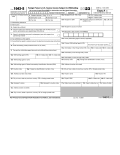
Download: PDF
Who Must File 1042-S?
The withholding agent, defined as the person with control or custody of an amount subject to withholding under chapter 3, or who makes a withholdable payment under chapter 4, must file 1042-S, even if no amount was actually withheld from the payment.[1]
The withholding agent may be an individual, a corporation, a qualified intermediary (QI), a nonqualified intermediary (NQI), a withholding foreign partnership (WP), a withholding foreign trust (WT), or a flow-through entity, among other possible entities.[2]
Electronic Reporting Requirement
Financial institutions, or any persons who must file 10 or more information returns, are required to file Form 1042-S electronically for tax year 2026.[3] 1042-S may be filed electronically using the IRIS System.
Who Receives a 1042-S?
In most cases, the withholding agent may treat the beneficial owner of the income as the recipient for the purposes of Form 1042-S. However, when the payment is made to someone other than the beneficial owner, such as a QI, WP, or WT, the agent may be required to treat that entity as the recipient. See the IRS instructions for more details.
Amounts Reported on 1042-S
Any amount paid to a foreign person from a U.S. source or included in a U.S. payee pool is subject to reporting on 1042-S, provided that the amount is reportable under chapters 3 and 4. Typically, the amount is reportable on 1042-S even if no withholding was applied.[4]
Common examples of reportable amounts include interest on deposits, corporate distributions, pensions, rent, and compensation for personal services performed. See the IRS instructions for the full list of amounts that are subject to reporting on Form 1042-S.
All amounts reported on 1042-S must be rounded off to the nearest whole dollar.[5]
Amounts Not Subject to Reporting on 1042-S
Interest on short-term obligations, bearer obligations targeted to foreign markets, and certain registered obligations targeted to foreign markets is not required to be reported on 1042-S.[6] Refer to the IRS website for the full list of reporting exceptions.
Deadlines
Form 1042-S must be filed with the IRS by March 15 of the following year. March 15 is also the deadline by which Copies B, C, and D must be furnished to the recipient.[7]
2027 Deadlines
- March 15, 2027 (both the IRS and the recipient)
Form Parts (70)
Unique Form Identifier
The withholding agent must provide a unique form identifier number on each Form 1042-S that they file. Enter this number in the unique form identifier box at the top of the form. This number must be exactly 10 digits and cannot be the recipient’s TIN.[8]
If you are filing an amended Form 1042-S, the unique form identifier on the amended form must be the same as the identifier on the original form.
Box 1: Income Code
Enter the two-digit income code to indicate the type of income being reported. If more than one type of income was paid to the same recipient, you must complete a separate Form 1042-S for each distinct income type.[9]
Refer to the IRS website for the list of income codes that can be used in this box.
Box 2: Gross Income
For the income type identified in box 1, enter the gross amount of income paid to or on behalf of the recipient during the calendar year, including withheld tax. Round this amount to the nearest whole dollar.[10]
Note that particular procedures apply to the reporting of gross income from PTP distributions, corporate distributions, and other special circumstances.
Box 3: Chapter Indicator
Enter either a “3” or a “4” to indicate whether the amounts withheld (or paid by the withholding agent) on the recipient’s income were withheld pursuant to chapter 3 or to chapter 4. A “3” or a “4” (but not both) must be entered on each 1042-S that you file.[11]
A “3” should be inserted in this box for any of the following special circumstances:
- Tax was withheld under section 5000C
- Backup withholding was applied under the presumption rules
- There was no withholding under either chapter 3 or 4
- You are reporting payments to U.S. payees
Boxes 3a and 4a: Chapter 3 and Chapter 4 Exemption Codes
Enter the corresponding exemption code to indicate whether the amounts reported in box 2 were exempt from chapter 3 or chapter 4 withholding. Enter “00” in box 3a and “00” in box 4a if an amount was withheld under chapter 3 and chapter 4, respectively.[12]
If the tax rate you enter in box 4b is 00.00, you must enter the applicable exemption code in box 4a. If the tax rate you enter in box 3b is due to backup withholding, leave box 3a blank.[12]
Refer to Appendix B on the IRS instructions website for a comprehensive list of exemption codes that can be used in these boxes. The IRS also provides more detailed instructions for common chapter 3 and chapter 4 exemption codes.
Boxes 3b and 4b: Chapter 3 and Chapter 4 Tax Rates
In these boxes, enter the correct rate of withholding that applies to the gross income reported in box 2 (or the net income reported in box 6, if applicable). Enter the correct rate of withholding even if an amount was withheld at a different rate.[13]
Refer to the IRS website for the table of valid tax rates for chapter 3 withholding. Be sure to enter the tax rate as four digits with a decimal point in the middle (e.g., “30.00”).
If the payment is subject to chapter 4 withholding, enter “30.00” in box 4b. If the amount reported in box 2 is not subject to chapter 4 withholding or is not a withholdable payment, enter “00.00” in box 4b and provide the relevant exemption code in box 4a.[13]
Box 5: Withholding Allowance
Only complete this box if the income code reported in box 1 is 16, 17, 18, 19, 20, or 42, and the recipient’s income is subject to a withholding allowance. Otherwise, leave this box blank.[14]
Box 6: Net Income
Only complete this box if you entered a withholding allowance amount in box 5. Otherwise, leave it blank.[15]
Box 7a: Federal Tax Withheld
In this box, enter the amount of U.S. federal tax actually withheld under chapter 3 or chapter 4. If you did not withhold any tax, enter “0.” Box 7a must always be completed on Form 1042-S.[16]
Box 7b: Escrow Procedures Checkbox
Check this box if the withholding agent was not required to deposit the withheld tax with the IRS because escrow procedures were applied to the payment.[17]
Box 7c: Partnership Interest Checkbox
Check this box if you are a partnership that received an amount subject to withholding during the calendar year, and you are withholding on the amount includible in a foreign partner’s share after March 15 of the subsequent year.
Only check this box if you designated the deposit as attributable to the calendar year.[18]
Box 8: Tax Withheld by Other Agents
If you are a withholding agent filing Form 1042-S to report income that has already been subject to withholding by another withholding agent, enter the amount actually withheld by the other agent(s) in this box.[19]
Box 9: Overwithheld Tax Repaid to Recipient
If you repaid a recipient under reimbursement or set-off procedures for overwithheld tax, and the repayment was made during the subsequent year (e.g., during 2024 for tax year 2023), enter the amount of tax repaid to the recipient in this box.
If the overwithheld tax was repaid during the calendar year, do not complete box 9. Instead, reduce the amount of withholding reported in box 7a.[20]
Box 10: Total Withholding Credit
In this box, enter the combined amount of federal tax withheld, tax withheld by other agents, and overwithheld tax repaid to the recipient reported in boxes 7a, 8, and 9, respectively.[21]
Box 10 must always be completed on Form 1042-S, even if no tax has been deposited.
Box 11: Tax Paid by Withholding Agent (Amounts Not Withheld)
Enter the total amount of tax paid by the withholding agent and not withheld from the payment to the recipient. The amount entered in this box should be amounts paid from the agent’s own funds and NOT through withholding from the recipient’s payment.[22]
Any amount reported in box 11 must not be included in box 10.
Box 12a: Withholding Agent’s Employer Identification Number (EIN)
Enter your employer identification number (EIN). If you are filing Form 1042-S as a QI, WP, or WT, enter your QI-EIN, WP-EIN, or WT-EIN, respectively. The withholding agent’s EIN cannot be truncated on Form 1042-S.[23]
Boxes 12b and 12c: Withholding Agent’s Chapter 3 and Chapter 4 Status Code
Enter the withholding agent’s chapter 3 and chapter 4 status codes in boxes 12b and 12c, respectively. Both a chapter 3 status code AND a chapter 4 status code must be entered on the form, regardless of the type of payment being made.[24]
Refer to the IRS Recipient Status Codes list to determine the correct withholding agent status code to use.
Boxes 12d through 12m: Withholding Agent’s Identifying Information
Enter the withholding agent’s name and address in the relevant boxes. If the agent has a foreign tax identification number (TIN), enter it in box 12g.[25]
In box 12e, enter the withholding agent’s GIIN, if applicable. This number should be the GIIN issued to the branch of the participating or registered deemed-compliant foreign financial institution (FFI), or the entity owned by the FFI, that is making the payment.[26]
In box 12f, enter the code for the country under whose tax laws the withholding agent is a resident. The list of applicable country codes can be found on the IRS website. If the withholding agent is a U.S. person, enter “US” in this box.[27]
Box 13a: Recipient Name
Enter the recipient’s name in this box. If you do not know the recipient’s name, or you are required to use the recipient status codes for an unknown recipient, enter “Unknown Recipient.”[28]
Note that special circumstances apply to how to complete this box for a QI, WP, or WT.
Boxes 13b through 13h: Recipient’s Country Code and Address
In box 13b, enter the code for the country under whose tax laws the recipient is a resident. Refer to the list of applicable country codes found on the IRS website.[29]
Enter the recipient’s full address in boxes 13c through 13h. For a foreign address, follow that country’s practice for entering the postal code.[30]
Box 13i: Recipient’s U.S. TIN
If you know the recipient’s TIN, you must enter it in box 13i.[31] The IRS also identifies several specific types of recipients for whom a U.S. TIN must be entered on Form 1042-S.
Boxes 13j and 13k: Recipient’s Chapter 3 and Chapter 4 Status Codes
Enter the recipient’s chapter 3 and chapter 4 status codes in boxes 13j and 13k, respectively. Refer to the IRS Recipient Status Codes list to determine the correct recipient status codes to use in these boxes.
A chapter 4 status code is only required if the payment is a withholdable payment or when an FFI provides a chapter 4 withholding rate pool of U.S. payees.[32] There are also specific instructions for which status codes must be used in certain situations.
Box 13l: Recipient’s GIIN
Enter the recipient’s GIIN, if applicable. You must include a GIIN on Form 1042-S if you are required to collect a GIIN for the recipient under chapter 4 requirements.[33]
Box 13m: Recipient’s Foreign Tax Identification Number
Enter the identification number used by the recipient for tax purposes in their country of residence. You must include a recipient’s foreign TIN if that information is available to you with respect to a financial account, or if the recipient is claiming a reduced tax rate under a tax treaty but has not provided a U.S. TIN.[34]
Box 13n: LOB Code
If the beneficial owner of the income is claiming a reduced withholding rate under a tax treaty, and they have provided documentation that establishes the limitation on benefits (LOB) article under which they qualify, enter the relevant LOB code in this box.[35]
Box 13o: Recipient’s Account Number
If you are a financial institution reporting amounts paid to a direct account holder with respect to an account maintained at your U.S. office or branch, you must report the recipient’s account number.
If the amount is paid through an NQI or flow-through entity, the recipient’s account number is not required.[36]
Box 13p: Recipient’s Date of Birth
Enter the recipient’s date of birth in YYYYMMDD format (e.g., 20001205 for a date of birth of December 5, 2000).[37] Note that special instructions govern how financial institutions must complete this box.
Boxes 14a and 14b: Primary Withholding Agent’s Name and EIN
If you are an intermediary or flow-through entity reporting amounts withheld by another withholding agent or agents, you must provide the name and EIN of the primary withholding agent that withheld the tax in boxes 14a and 14b, respectively.
If you are not reporting tax withheld by other agents, leave these boxes blank.[38]
Box 15: Pro-Rata Basis Reporting Checkbox
If a nonqualified intermediary (NQI) is using the IRS’s alternative procedures to provide information on the allocation of a reportable payment, and if the NQI has failed to comply with these procedures, check this box.[39]
Boxes 15a through 15m: Intermediary/Flow-Through Entity’s Information
If the recipient’s documentation was submitted to you along with a Form W-8IMY from an intermediary or flow-through entity, you must provide that entity’s name, status code, country code, address, EIN, GIIN, and foreign TIN in these boxes.[40]
Boxes 16a through 16e: Payer’s Name, TIN, GIIN, and Status Code
If you are the authorized agent acting on behalf of a payer, enter the payer’s name, TIN, GIIN, and status code in these boxes. Only enter the payer’s name, TIN, and GIIN if they are different from the information entered in boxes 12a, 12d, and 12e.[41]
Refer to the IRS Recipient Status Code list to determine what codes to enter in boxes 16d and 16e.
Boxes 17a through 17c: State Income Tax Withheld
If any state income tax was withheld, enter the amount withheld, the payer’s state tax number, and the name of the state in boxes 17a, 17b, and 17c, respectively.[42]
How to File
Form 1042-S may be filed electronically or using paper copies printed off of the IRS website.
- Collect the appropriate Form W-8 for the recipient
- Choose a filing method (electronically with IRIS, by mail, or with third-party software. Skip ahead to step 5 if you are filing online.)
- Complete Form 1042-T along with Copy A if you are filing by mail
- Mail Form 1042-T and Copy A to the Ogden Service Center, P.O. Box 409101,
Ogden, UT 84409[43] - Send Copies B, C, and D to the recipient
- Retain Copy E for your records
Frequently Asked Questions (FAQs)
Where do I report the information from my 1042-S on my tax return?
How you report the information from 1042-S on your taxes depends on the nature of your income and whether you were engaged in a trade or business. Refer to the IRS instructions for Form 1040-NR to determine whether you are required to file an income tax return and what information from your 1042-S you must include.
What is the difference between Form 1042 and Form 1042-S?
While 1042-S is used primarily to report payments from a U.S. source received by a foreign person, Form 1042 is mainly used to report the tax withheld on the American income of a foreign person.[44]
How does the IRS define “foreign person”?
As used by the IRS, the term “foreign person” typically refers to an individual who is not a U.S. citizen or resident, but it could also mean a foreign corporation, partnership, trust, or estate, or the foreign branch of a U.S. financial institution or clearing organization.[45]
Sources
- IRS – Who Must File
- IRS – Withholding Agent Definition
- IRS – Electronic Reporting
- IRS – Amounts Subject to Reporting
- IRS – Rounding Off to Whole Dollars
- IRS – Amounts Not Subject to Reporting
- IRS – Guide to Information Returns
- IRS – Unique Form Identifier Instructions
- IRS – Income Code Box Instructions
- IRS – Gross Income Box Instructions
- IRS – Chapter Indicator Box Instructions
- IRS – Boxes 3a and 4a Instructions
- IRS – Boxes 3b and 4b Instructions
- IRS – Withholding Allowance Box Instructions
- IRS – Net Income Box Instructions
- IRS – Federal Tax Withheld Box Instructions
- IRS – Escrow Procedures Checkbox Instructions
- IRS – Partnership Interest Checkbox Instructions
- IRS – Tax Withheld by Other Agents Box Instructions
- IRS – Overwithheld Tax Repaid Box Instructions
- IRS – Total Withholding Credit Box Instructions
- IRS – Tax Paid by Withholding Agent Box Instructions
- IRS – Withholding Agent’s EIN Box Instructions
- IRS – Withholding Agent’s Status Code Boxes Instructions
- IRS – Withholding Agent’s Identifying Information Boxes Instructions
- IRS – Withholding Agent’s GIIN Box Instructions
- IRS – Country Code Box Instructions
- IRS – Recipient Name Box Instructions
- IRS – Recipient Country Code Box Instructions
- IRS – Recipient’s Address Boxes Instructions
- IRS – Recipient TIN Box Instructions
- IRS – Recipient Status Codes Boxes Instructions
- IRS – Recipient GIIN Box Instructions
- IRS – Recipient FTIN Box Instructions
- IRS – LOB Code Box Instructions
- IRS – Recipient Account Number Box Instructions
- IRS – Recipient Date of Birth Box Instructions
- IRS – Primary Withholding Agent Name and EIN Boxes Instructions
- IRS – Pro-Rata Basis Reporting Checkbox Instructions
- IRS – Intermediary/Flow-Through Entity Identifying Information Box Instructions
- IRS – Payer Information Boxes Instructions
- IRS – State Income Tax Withheld Boxes Instructions
- IRS – Form 1042-T Instructions
- IRS – Form 1042 Purpose of Form
- IRS – Foreign Person Definition