
Key Features
- Defines who gets what. Clearly defines the financial arrangement, mainly, how much the consignee is paid for selling the goods.
- Proves ownership retention. Even though the consignee will take possession while attempting to sell the goods, an agreement defines that this does not constitute a transfer of title.
- Controls pricing ($). Allows the consignor to set the suggested price, but with the consignee having the power to allow discounts or deductions.
- Handling returns. Sets the rules for goods that are returned and the process for refunding the money back to the consignee (or deducting from future sales).
- Protects against abandonment. To reduce the chance of unsold inventory, the consignee is protected by being allowed to dispose of items that do not sell (and are not retrieved by the consignor).
By Type (2)
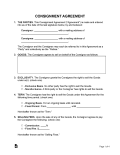 Single-Item – When a single item is being sold. This is common for higher-priced items such as a vehicle, jewelry, a painting, or other one-off sales. Single-Item – When a single item is being sold. This is common for higher-priced items such as a vehicle, jewelry, a painting, or other one-off sales.
|
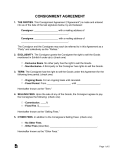 Multiple Items – When multiple items are being sold, a consignor-consignee relationship is started. It includes an attached addendum that acts as an inventory checklist and the suggested price for each item. Multiple Items – When multiple items are being sold, a consignor-consignee relationship is started. It includes an attached addendum that acts as an inventory checklist and the suggested price for each item.
|
Consignment Fees (%)
| Common Fees | |
| Agriculture/Produce | 10%[1] |
| Antiques | 60%[2] |
| Art | 60%[3] |
| Auction | 30-50%[4] |
| Books | 40%[5] |
| Clothing | 40%[6] |
| Equipment | 5-10%[7][8] |
| Firearms | 15-25%[9][10][11] |
| Furniture | 30-50%[12] |
| Jewelry | 25-50%[13] |
| Livestock | 2-12% plus a “head fee”[14][15] |
| Retail | 40%[16] |
| Stock | 1-2%[17] |
| Vehicles | 10-15%[18] |
Important Clauses (7)
1. Exclusivity
An exclusivity clause allows the consignee to be the only seller of the goods or must share this right with other parties, including the consignor.
- If exclusive, the consignee is owed a commission no matter who sells the goods.
- If non-exclusive, the consignee is only owed a commission if the sale of the goods is conducted through them, directly or indirectly.
5. Discount Authority
The discount authority is the consignee’s ability to negotiate a lower price with potential buyers without obtaining the consignor’s permission.A consignor will typically enter a list price and a minimum price, and the consignee is able to negotiate the difference with the discount authority.
6. Payout Schedule
A payout schedule is when the consignee is required to pay the consignor after the sale of the goods.
- Single-item. Payment is commonly due within 30 days after the sale is complete.
- Multiple items. For an ongoing relationship, payment is usually conducted at the end of each month.
Sample
Sources
- www.svproduceauction.com/seller-info/
- www.bestconsignmentshopsoftware.com/consignment-percentage.htm
- www.madeurban.com/blog/what-is-a-fair-consignment-percentage/
- www.nesa-usa.com/how-much-to-pay
- www.odysseybks.com/consignment-odyssey
- www.charlottebcloset.com/how-much-do-consignment-stores-charge/
- www.jerremartinrepair.com/consign.htm
- www.cattletoday.com/threads/commission-rate-for-selling-equipment.122295/
- www.centermassinc.com/consignment
- www.thebunkergunshop.com/consignment
- www.support.gunbroker.com/hc/en-us/articles/29618999336987-Sell-your-Gun-with-Confidence
- www.blog.remoovit.com/2024/12/01/how-much-do-furniture-consignment-stores-charge/
- www.jewelersmutual.com/resources/individuals/how-buy/where-sell-jewelry-your-options-explained
- www.superiorlivestock.com/terms-conditions/
- www.atlanticprojectcargo.com/insights/us-livestock-auctions-a-complete-guide/
- www.bestconsignmentshopsoftware.com/consignment-percentage.htm
- www.sofi.com/learn/content/average-stock-broker-commission-percentage/
- www.centralauctiongroup.com/auction-fees-expenses/